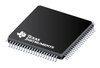

更多产品参数
RISC Microcontroller, 16-Bit, FRAM, MSP430 CPU, 16MHz, CMOS, PQFP100
制造商:
Texas Instruments
制造商型号:
MSP430FR6989IPZ
符合标准:
Rohs 符合
不含铅
数据手册:
文档下载
MSP430FR6989IPZ数据表
参考设计(23)
TIDM-TMR-WATERMTR Ultra-Low Power Flow Meter Using TMR Sensors Reference Design for extended system longevity | TI.com
TIDM-TMR-WATERMTR: When designing battery-powered applications, ultra-low power consumption is the key factor in extending the lifetime of a system. Long-running designs must not waste the energy they are provided. This TI design highlights the usage of TMR sensor and Extended Scan Interface (ESI) to archive ultra-low power rotation detection for flow meter application. This design uses the evaluation kit EVM430-FR6989 and the custom TMR sensor board for testing.
Code Generation and Optimization With FlowESI GUI and EnergyTrace Reference Design
TIDM-FLOWESI-ETRACE: When designing battery-powered applications, ultra-low power consumption is the key factor in extending the lifetime of a system. Long-running designs must not waste the energy they are provided. Despite choosing appropriate low-power hardware components, firmware also takes an important role to reduce power consumption. This TI design highlights the usage of FlowESI GUI and the EnergyTrace technology to help developers to design and optimize ultra-low-power applications on the EVM430-FR6989.
Power Solution for Battery Operated Meters With 30-dBm wM-Bus at 169 MHz Reference Design
TIDA-00676: This power management solution delivering 900mA @3.6V from various battery types for smart flow metering applications (residential gas and water meters). TIDA-00676 includes an ETSI Cat. 1 receiver capable RF subsystem for wM-Bus @ 169 MHz with up to +30 dBm transmit power meets all technical requirements for 169MHz RF links in Italy and France. Power management and RF sub-systems can be equally well used in data collectors and other end nodes (E-meter or In-Home Display) with wM-Bus@ 169 MHz links.
Water Meter Reference Design for Optical Sensors, Using Extended Scan Interface (ESI)
TIDM-OPTICALWATERMTR: One of the challenges in battery operated water meters is to continuously measure the water flow information while consuming as little energy as possible. The EVM430-FR6989 used in this design features a MSP430 FRAM-based microcontroller with 100uA/MHz active-mode current, 450nA standby-mode current with the real-time clock enabled, and integrated low-power analog and digital peripherals. Additionally, the MCU offers for near infinite write endurance, quick/low-power writes, and data flexibility. This reference design demonstrates a usage example of the integrated Extended Scan Interface (ESI) on the microcontroller to achieve ultra-low power consumption compared with the same detecting methodology using an external circuit. In water meter designs, coupled to an optical rotation detection sensor (provided), the ESI is continuously detecting the rotation of the propeller while the rest of the microcontroller is in a low-power mode. By using the ESI integrated in the MSP430 MCU, this design automates the measurement process and reduces CPU involvement, which helps to reduce overall power consumption.
Ultrasonic Water Flow Meter Design using Time to Digital Conversion
TIDM-ULTRASONIC-FLOW-TDC: The TIDM-ULTRASONIC-FLOW-TDC is a reference design for an ultrasonic flow meter (water, gas or heat meter) with LCD built using a Time-to-Digital converter and an ultra-low power MCU. Solution includes optimized leakage detection, low power consumption, and a small form factor that are important requirements for water, heat and gas meter applications. This design also includes a high efficiency DC-DC converter for system power.
Water Meter Reference Design for GMR Sensors, Using Extended Scan Interface (ESI)
TIDM-GMR-WATERMTR: One of the challenges in battery operated water meters is to continuously measure the water flow information while consuming as little energy as possible. The EVM430-FR6989 used in this design features a MSP430 FRAM-based microcontroller with 100uA/MHz active-mode current, 450nA standby-mode current with the real-time clock enabled, and integrated low-power analog and digital peripherals. Additionally, the MCU offers for near infinite write endurance, quick/low-power writes, and data flexibility. This reference design demonstrates a usage example of the integrated Extended Scan Interface (ESI) on the microcontroller to achieve ultra-low power consumption compared with the same detecting methodology using an external circuit. In water meter designs, coupled to a Giant magneto-resistive (GMR) rotation detection sensor (provided), the ESI is continuously detecting the rotation of the propeller while the rest of the microcontroller is in a low-power mode. By using the ESI integrated in the MSP430 MCU, this design automates the measurement process and reduces CPU involvement, which helps to reduce overall power consumption.
TIDM-GMR-WATERMTR Water Meter Reference Design for GMR Sensors, Using Extended Scan Interface (ESI) | TI.com
TIDM-GMR-WATERMTR: One of the challenges in battery operated water meters is to continuously measure the water flow information while consuming as little energy as possible. The EVM430-FR6989 used in this design features a MSP430 FRAM-based microcontroller with 100uA/MHz active-mode current, 450nA standby-mode current with the real-time clock enabled, and integrated low-power analog and digital peripherals. Additionally, the MCU offers for near infinite write endurance, quick/low-power writes, and data flexibility. This reference design demonstrates a usage example of the integrated Extended Scan Interface (ESI) on the microcontroller to achieve ultra-low power consumption compared with the same detecting methodology using an external circuit. In water meter designs, coupled to a Giant magneto-resistive (GMR) rotation detection sensor (provided), the ESI is continuously detecting the rotation of the propeller while the rest of the microcontroller is in a low-power mode. By using the ESI integrated in the MSP430 MCU, this design automates the measurement process and reduces CPU involvement, which helps to reduce overall power consumption.
Water Meter Reference Design for three LC Sensors, Using Extended Scan Interface (ESI)
TIDM-3LC-METER-CONV: One of the challenges in battery operated water meters is to continuously measure the water flow information while consuming as little energy as possible. The EVM430-FR6989 used in this design features a MSP430 FRAM-based microcontroller with 100uA/MHz active-mode current, 450nA standby-mode current with the real-time clock enabled, and integrated low-power analog and digital peripherals. Additionally, the MCU offers for near infinite write endurance, quick/low-power writes, and data flexibility. This reference design demonstrates a usage example of the integrated Extended Scan Interface (ESI) on the microcontroller to achieve ultra-low power consumption compared with the same detecting methodology using an external circuit. In water meter designs, coupled to 3 LC rotation detection sensors, the ESI is continuously detecting the rotation of the propeller while the rest of the microcontroller is in a low-power mode. By using the ESI integrated in the MSP430 MCU, this design automates the measurement process and reduces CPU involvement, which helps to reduce overall power consumption
TIDM-FRAM-EEPROM EEPROM Emulation and Sensing With MSP430 FRAM Microcontrollers | TI.com
TIDM-FRAM-EEPROM: This TI Design reference design describes an implementation of emulating EEPROM using Ferroelectric Random Access Memory (FRAM) technology on MSP430™ ultra-low-power microcontrollers (MCUs) combined with the additional sensing capabilities that can be enabled when using an MCU. The reference design supports both I2C and SPI interface to a host processor with multiple slave addressing.
Zero Standby Power NFC for Flow Meter Designs Reference Design
TIDM-NFC-WATERMTR: This TI Design demonstrates adding Near Field Communications (NFC) capability to flow meters. The NFC Interface Transponder provides data exchange capability between flow meters and NFC readers and is compliant to ISO14443B. The transponder used in this design consumes no power while waiting to be energized by a RF field generated by the NFC reader. In addition, this design can be powered by harvesting the energy from the RF field generated by the NFC readers. These two approaches minimize the power consumption impact to the flow meters.
TIDA-00676 Power Solution for Battery Operated Meters With 30-dBm wM-Bus at 169 MHz Reference Design | TI.com
TIDA-00676: This power management solution delivering 900mA @3.6V from various battery types for smart flow metering applications (residential gas and water meters). TIDA-00676 includes an ETSI Cat. 1 receiver capable RF subsystem for wM-Bus @ 169 MHz with up to +30 dBm transmit power meets all technical requirements for 169MHz RF links in Italy and France. Power management and RF sub-systems can be equally well used in data collectors and other end nodes (E-meter or In-Home Display) with wM-Bus@ 169 MHz links.
TIDM-INDUCTIVEPROX MSP430 Microcontroller Single Chip Inductive Proximity Sensing Reference Design | TI.com
TIDM-INDUCTIVEPROX: Historically, inductive sensing technique has required complex, analog-only circuitry, making it a costly technique for applications outside of industrial controls or portable metal detectors. To provide a low cost inductive sensing solution for designers, this reference design describes the implementation of the ultra-low power single chip solution for inductive proximity sensor by using TI Extended Scan Interface module on MSP430 microcontrollers. This reference design also uses three different LC sensors to demonstrate the compatibility of ESI module and calibration routine with different type and size of inductors
Water Meter Reference Design for two LC Sensors, Using Extended Scan Interface (ESI)
TIDM-LC-WATERMTR: One of the challenges in battery operated water meters is to continuously measure the water flow information while consuming as little energy as possible. The EVM430-FR6989 used in this design features a MSP430 FRAM-based microcontroller with 100uA/MHz active-mode current, 450nA standby-mode current with the real-time clock enabled, and integrated low-power analog and digital peripherals. Additionally, the MCU offers for near infinite write endurance, quick/low-power writes, and data flexibility. This reference design demonstrates a usage example of the integrated Extended Scan Interface (ESI) on the microcontroller to achieve ultra-low power consumption compared with the same detecting methodology using an external circuit. In water meter designs, coupled to LC rotation detection sensor (provided), the ESI is continuously detecting the rotation of the propeller while the rest of the microcontroller is in a low-power mode. By using the ESI integrated in the MSP430 MCU, this design automates the measurement process and reduces CPU involvement, which helps to reduce overall power consumption. To purchase the kit, please see the EVM430-FR6989 page.
TIDM-FLOWESI-ETRACE Code Generation and Optimization With FlowESI GUI and EnergyTrace Reference Design | TI.com
TIDM-FLOWESI-ETRACE: When designing battery-powered applications, ultra-low power consumption is the key factor in extending the lifetime of a system. Long-running designs must not waste the energy they are provided. Despite choosing appropriate low-power hardware components, firmware also takes an important role to reduce power consumption. This TI design highlights the usage of FlowESI GUI and the EnergyTrace technology to help developers to design and optimize ultra-low-power applications on the EVM430-FR6989.
TIDM-OPTICALWATERMTR Water Meter Reference Design for Optical Sensors, Using Extended Scan Interface (ESI) | TI.com
TIDM-OPTICALWATERMTR: One of the challenges in battery operated water meters is to continuously measure the water flow information while consuming as little energy as possible. The EVM430-FR6989 used in this design features a MSP430 FRAM-based microcontroller with 100uA/MHz active-mode current, 450nA standby-mode current with the real-time clock enabled, and integrated low-power analog and digital peripherals. Additionally, the MCU offers for near infinite write endurance, quick/low-power writes, and data flexibility. This reference design demonstrates a usage example of the integrated Extended Scan Interface (ESI) on the microcontroller to achieve ultra-low power consumption compared with the same detecting methodology using an external circuit. In water meter designs, coupled to an optical rotation detection sensor (provided), the ESI is continuously detecting the rotation of the propeller while the rest of the microcontroller is in a low-power mode. By using the ESI integrated in the MSP430 MCU, this design automates the measurement process and reduces CPU involvement, which helps to reduce overall power consumption.
TIDM-3LC-METER-CONV Water Meter Reference Design for three LC Sensors, Using Extended Scan Interface (ESI) | TI.com
TIDM-3LC-METER-CONV: One of the challenges in battery operated water meters is to continuously measure the water flow information while consuming as little energy as possible. The EVM430-FR6989 used in this design features a MSP430 FRAM-based microcontroller with 100uA/MHz active-mode current, 450nA standby-mode current with the real-time clock enabled, and integrated low-power analog and digital peripherals. Additionally, the MCU offers for near infinite write endurance, quick/low-power writes, and data flexibility. This reference design demonstrates a usage example of the integrated Extended Scan Interface (ESI) on the microcontroller to achieve ultra-low power consumption compared with the same detecting methodology using an external circuit. In water meter designs, coupled to 3 LC rotation detection sensors, the ESI is continuously detecting the rotation of the propeller while the rest of the microcontroller is in a low-power mode. By using the ESI integrated in the MSP430 MCU, this design automates the measurement process and reduces CPU involvement, which helps to reduce overall power consumption
MSP430 Microcontroller Single Chip Inductive Proximity Sensing Reference Design
TIDM-INDUCTIVEPROX: Historically, inductive sensing technique has required complex, analog-only circuitry, making it a costly technique for applications outside of industrial controls or portable metal detectors. To provide a low cost inductive sensing solution for designers, this reference design describes the implementation of the ultra-low power single chip solution for inductive proximity sensor by using TI Extended Scan Interface module on MSP430 microcontrollers. This reference design also uses three different LC sensors to demonstrate the compatibility of ESI module and calibration routine with different type and size of inductors
TIDM-INDUCTIVELINEAR ESI + LDC Inductive Linear Position Sensing Reference Design | TI.com
TIDM-INDUCTIVELINEAR: Typical implementations of linear position measurements use expensive rare-earth magnets. To lower the overall system cost, this reference design describes the implementation of using the industry’s first inductance-to-digital converters (LDC) from TI for linear position sensing without the use of any expensive rare-earth magnets. This reference design also describes the implementation of the ultra-low power two chip solution for inductive linear position sensors by using TI's extended scan interface (ESI) module on the MSP430(TM) microcontrollers (MCUs) and LDC1612 chip. By combining the ESI module on MSP430 MCU and the LDC technology, the reference design provides the designer a low-cost and low-power inductive linear position sensing solution.
TIDM-FRAM-CTPL Intelligent System State Restoration after Power Failure with Compute Through Power Loss Utility | TI.com
TIDM-FRAM-CTPL: Compute Through Power Loss (CTPL) is a software utility for ultra-low-power MSP430FRxx FRAM microcontrollers that enables an application to easily save the CPU and peripheral states into non-volatile FRAM, before powering down or entering a deep-sleep mode like LPMx.5. CTPL then automatically restores the application where the application last executed (this is also referred to as context-save and restore). This TI design showcases how one can easily integrate the utility library to be used in their application. CTPL can enable a faster wake-up time from cold-start by bypassing the startup routine which can be cycle intensive.
TIDM-LC-WATERMTR Water Meter Reference Design for two LC Sensors, Using Extended Scan Interface (ESI) | TI.com
TIDM-LC-WATERMTR: One of the challenges in battery operated water meters is to continuously measure the water flow information while consuming as little energy as possible. The EVM430-FR6989 used in this design features a MSP430 FRAM-based microcontroller with 100uA/MHz active-mode current, 450nA standby-mode current with the real-time clock enabled, and integrated low-power analog and digital peripherals. Additionally, the MCU offers for near infinite write endurance, quick/low-power writes, and data flexibility. This reference design demonstrates a usage example of the integrated Extended Scan Interface (ESI) on the microcontroller to achieve ultra-low power consumption compared with the same detecting methodology using an external circuit. In water meter designs, coupled to LC rotation detection sensor (provided), the ESI is continuously detecting the rotation of the propeller while the rest of the microcontroller is in a low-power mode. By using the ESI integrated in the MSP430 MCU, this design automates the measurement process and reduces CPU involvement, which helps to reduce overall power consumption. To purchase the kit, please see the EVM430-FR6989 page.
TIDM-ULTRASONIC-FLOW-TDC Ultrasonic Water Flow Meter Design using Time to Digital Conversion | TI.com
TIDM-ULTRASONIC-FLOW-TDC: The TIDM-ULTRASONIC-FLOW-TDC is a reference design for an ultrasonic flow meter (water, gas or heat meter) with LCD built using a Time-to-Digital converter and an ultra-low power MCU. Solution includes optimized leakage detection, low power consumption, and a small form factor that are important requirements for water, heat and gas meter applications. This design also includes a high efficiency DC-DC converter for system power.
TIDM-NFC-WATERMTR Zero Standby Power NFC for Flow Meter Designs Reference Design | TI.com
TIDM-NFC-WATERMTR: This TI Design demonstrates adding Near Field Communications (NFC) capability to flow meters. The NFC Interface Transponder provides data exchange capability between flow meters and NFC readers and is compliant to ISO14443B. The transponder used in this design consumes no power while waiting to be energized by a RF field generated by the NFC reader. In addition, this design can be powered by harvesting the energy from the RF field generated by the NFC readers. These two approaches minimize the power consumption impact to the flow meters.
Low Power Flow Meter Using TMR Sensors Reference Design
TIDM-TMR-WATERMTR: The TIDM-TMR-WATERMTR is a reference design for detecting flow of the mechanical flow meters using the Extended Scan Interface (ESI) and the TMR sensor. The ESI is designed for measuring linear or rotational motion at the lowest possible power consumption while the processor does not get involved. The ESI supports different sensors to suit different applications. This design uses the evaluation kit EVM430-FR6989 and the custom TMR sensor board for testing.